

TL;DR:
- Texas energy rates are complex due to market deregulation and fluctuating wholesale costs.
- Prepaid and no-deposit plans offer quick activation and are ideal for those with limited credit.
- Comparing plans requires analyzing fees, rate structure, and the Electricity Facts Label for true costs.
Two neighbors in the same Texas city can pay wildly different electric bills every month, even when they use the same amount of power. That’s not a glitch. It’s the result of a deregulated energy market that gives you real choices but also real complexity. If you have limited credit or need power turned on fast, navigating this system can feel overwhelming. This guide breaks down exactly how Texas energy rates work, what drives your bill up or down, and how to lock in an affordable plan with quick activation, no hefty deposit required.
Table of Contents
- Why Texas energy rates are so confusing
- What actually determines your energy rate in Texas?
- How to compare plans and spot hidden fees
- Finding fast, affordable electricity with limited credit
- The real story: What most Texans get wrong about energy rates
- Get power today: Fast, no-deposit Texas electricity options
- Frequently asked questions
Key Takeaways
| Point | Details |
|---|---|
| Deregulation increases choice | Texas residents can pick from many power providers to find affordable plans, especially helpful for those with limited credit. |
| Prepaid options speed activation | Prepaid and no-deposit plans allow quick electricity setup and eliminate credit check barriers. |
| Know your plan details | Understanding all fees and rate structures is key to avoiding surprise bills and saving money. |
| Summer means higher bills | Expect electricity costs to rise sharply in summer months due to heavy air conditioner use. |
Why Texas energy rates are so confusing
Before 2002, your electricity rate was set by the state. One utility, one price, no shopping required. Then Texas deregulated its electricity market, and suddenly dozens of retail electric providers (REPs) were competing for your business. That sounds like a win, and in many ways it is. But it also means the responsibility of finding a good deal shifted entirely to you.
“Deregulation lowered rates long-term but created early extra costs and price volatility.”
The history of Texas market deregulation shows that while competition eventually pushed prices down, the transition introduced real confusion for everyday consumers. Rates fluctuate based on wholesale energy markets, provider pricing strategies, and the type of plan you choose. That’s a lot of moving parts.
For residents with limited credit, the confusion runs even deeper. Many providers require a credit check before they’ll activate service. If your score doesn’t meet their threshold, they demand a deposit, sometimes several hundred dollars. That’s a serious barrier if you need power today and don’t have that cash sitting around. Understanding no-deposit plans explained is the first step toward cutting through that barrier.
Here are the most common pain points Texas residents run into:
- Hidden fees buried in the fine print, like base charges that apply even on low-usage months
- Confusing rate structures that show a low per-kWh rate but only at specific usage thresholds
- Surprise bills caused by variable rates that spike during high-demand periods
- Credit requirements that block fast activation for those without strong credit history
If you’ve ever felt like the system is stacked against you, you’re not imagining it. But options with limited credit do exist, and knowing where to look changes everything. Following clear energy choice steps can make the process far less stressful.
What actually determines your energy rate in Texas?
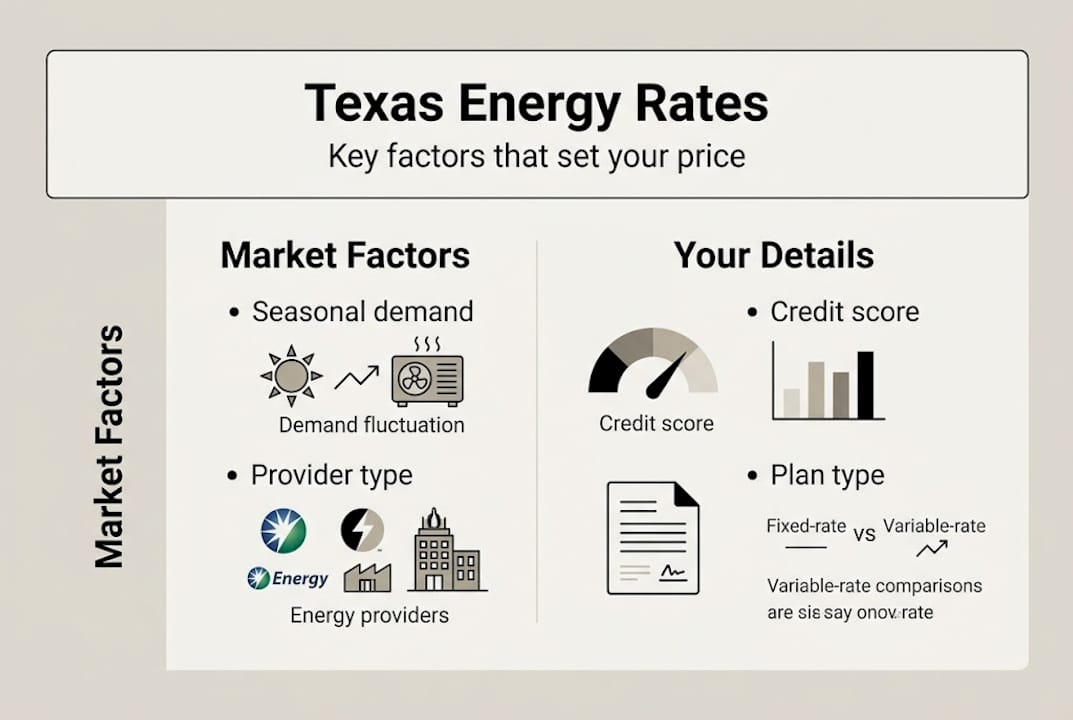
Now that we know why the market is confusing, let’s pinpoint what actually shapes the rates you see on your bill. There are four main components that drive your electricity cost in Texas.
- Wholesale energy cost: This is the price providers pay to purchase electricity on the open market. It fluctuates daily based on demand, weather, and fuel prices.
- Delivery charges: Your local utility (like Oncor, CenterPoint, or AEP) charges fees to maintain the power lines and infrastructure that deliver electricity to your home. These fees are fixed regardless of your provider.
- Provider fees: Each REP adds its own margin, service fees, and sometimes a base charge just for being a customer.
- Plan extras: Features like green energy sourcing, prepaid billing, or smart usage alerts can affect your total rate.
Your credit score plays a direct role too. Providers use it to decide whether you qualify for standard postpaid service or whether you’ll need to pay a deposit upfront. For many Texans, prepaid plans are the smarter path because they skip the credit check entirely. Understanding bill factors for prepaid plans helps you see exactly where your money goes each month.
| Plan Type | Rate Structure | Deposit Required | Activation Speed |
|---|---|---|---|
| Fixed rate | Locked for contract term | Often yes | 1-3 business days |
| Variable rate | Changes monthly | Sometimes | 1-3 business days |
| Prepaid/no-deposit | Pay as you go | No | Same day |
Seasonality is a major factor that catches people off guard. Average Texas bills run between $177 and $221 per month, based on usage of 1,176 to 1,541 kWh at roughly 14 to 15 cents per kWh. In summer, air conditioning pushes usage through the roof, and bills can climb well above that range. Knowing this in advance helps you budget smarter and choose a plan that won’t blindside you in July.

Pro Tip: If you’re worried about credit barriers, look specifically at variable rate plans or prepaid options. Prepaid plans let you load money onto your account and use power as you go, with no deposit and no credit check required.
How to compare plans and spot hidden fees
Understanding rate components sets you up to compare actual offers. Here’s how to do it smartly so you don’t get burned by a plan that looked great on the surface.
Every Texas electricity plan comes with an Electricity Facts Label (EFL). Think of it like a nutrition label for your energy plan. It lists the actual rate at different usage levels, all fees, contract length, and cancellation penalties. Always request the EFL before signing up.
Pro Tip: A plan advertising 9.9 cents per kWh might only apply at exactly 1,000 kWh per month. Use more or less, and the effective rate jumps significantly. The EFL reveals this.
Here’s a checklist of what to review before committing to any plan:
- Base rate per kWh at your actual usage level (not just the advertised rate)
- Monthly base charge (a flat fee you pay regardless of usage)
- Delivery fees from your local utility
- Early cancellation fees if you need to switch before the contract ends
- Payment convenience fees for paying by card or phone
- Paper billing fees (yes, some providers charge for mailed statements)
For context, monthly usage costs for Texas households average between $177 and $221, but hidden fees can push that number higher without you realizing why. A plan with a slightly higher base rate but zero extra fees can actually cost less than a “cheap” plan loaded with add-on charges.
Strategies for managing energy costs in Texas start with this comparison step. Don’t skip it, even if you’re in a hurry to get power turned on.
Finding fast, affordable electricity with limited credit
Once you know what to look for and how to compare plans, here’s how to act fast for hassle-free power, no credit score needed.
The market flexibility created by Texas deregulation means prepaid and no-deposit plans are a legitimate, widely available option. You’re not settling for a second-tier product. You’re using the system the way it was designed to work.
Here’s a step-by-step process to get power quickly:
- Compare providers that offer true prepaid or no-deposit plans in your area.
- Select your plan based on the EFL review and fee checklist above.
- Submit your information: You’ll typically need a government-issued ID and proof of your service address.
- Activate your service: Many providers can flip the switch within hours, not days.
- Load your account with an initial balance if you’re on a prepaid plan, then monitor usage through the provider’s app or online portal.
Typical activation timeline: same day to 24 hours. Have your ID, address, and a payment method ready before you start the signup process to avoid delays.
Pro Tip: Pay-as-you-go prepaid plans are excellent for budgeting because you can top up your account in small amounts and get low-balance alerts before your power is interrupted. No surprise shutoffs.
One thing to watch out for is a “switch hold.” If your meter is flagged for a switch hold (usually due to a recent provider change), your new service activation can be delayed by a few days. Ask your new provider upfront whether a switch hold could affect your address. Exploring no-deposit power options with providers who know how to navigate these situations can save you a major headache.
The real story: What most Texans get wrong about energy rates
Most people chase the lowest advertised rate and call it a day. That’s the wrong move. The rate per kWh is just one number in a much bigger equation. Fees, contract terms, and billing structure can easily cost you more than a slightly higher rate ever would.
Here’s something the industry doesn’t advertise: prepaid and no-deposit plans aren’t the expensive last resort they’re sometimes made out to be. For many Texas residents, especially those who need fast activation or want to avoid credit barriers, they’re actually the most cost-effective path. You pay for what you use, you skip the deposit, and you stay in control of your spending.
Deregulation put real power in your hands. But only if you use it. Most people pick a provider once and never look back, even as better deals emerge. We recommend understanding Texas rates at least once a year and re-evaluating your plan when your contract ends. The market changes, and so do your energy needs.
Don’t let the complexity of the Texas electricity market convince you that you have no good options. The fine print is where the real story lives, and once you know how to read it, you’re in a much stronger position than most.
Get power today: Fast, no-deposit Texas electricity options
Now that you know how the system works, getting started is the easy part. Same Day Electricity offers prepaid and no-deposit plans designed for exactly this situation: fast approval, no credit check, and activation that can happen the same day you apply.

Apply online in minutes and get power turned on without waiting for a credit review or scraping together a deposit. Service is available across Texas, including prepaid electricity in Temple, Houston, Arlington, and dozens of other cities. Whether you need no-deposit power in Texas or want to explore same-day energy activation, the process is straightforward and built around your needs.
Frequently asked questions
How much does the average electric bill cost in Texas?
The average Texas bill ranges from $177 to $221 per month, but summer air conditioning use can push that number significantly higher.
Are prepaid electricity plans more expensive in Texas?
Prepaid plans may carry slightly higher per-kWh rates, but they eliminate deposits and credit checks, making them a more affordable option for many residents with limited credit.
How fast can I get same-day electricity in Texas?
Most reliable providers can activate service the same day you apply, often within a few hours once your information is submitted and verified.
What plan type is best if I have low credit or no deposit money?
Prepaid and true no-deposit plans are your best bet since they require no credit check or upfront deposit and typically activate faster than standard plans.
Why do Texas energy bills spike in the summer?
Air conditioning dramatically increases electricity consumption during hot months, and higher summer demand drives up both usage and, in some cases, the rate itself on variable plans.